
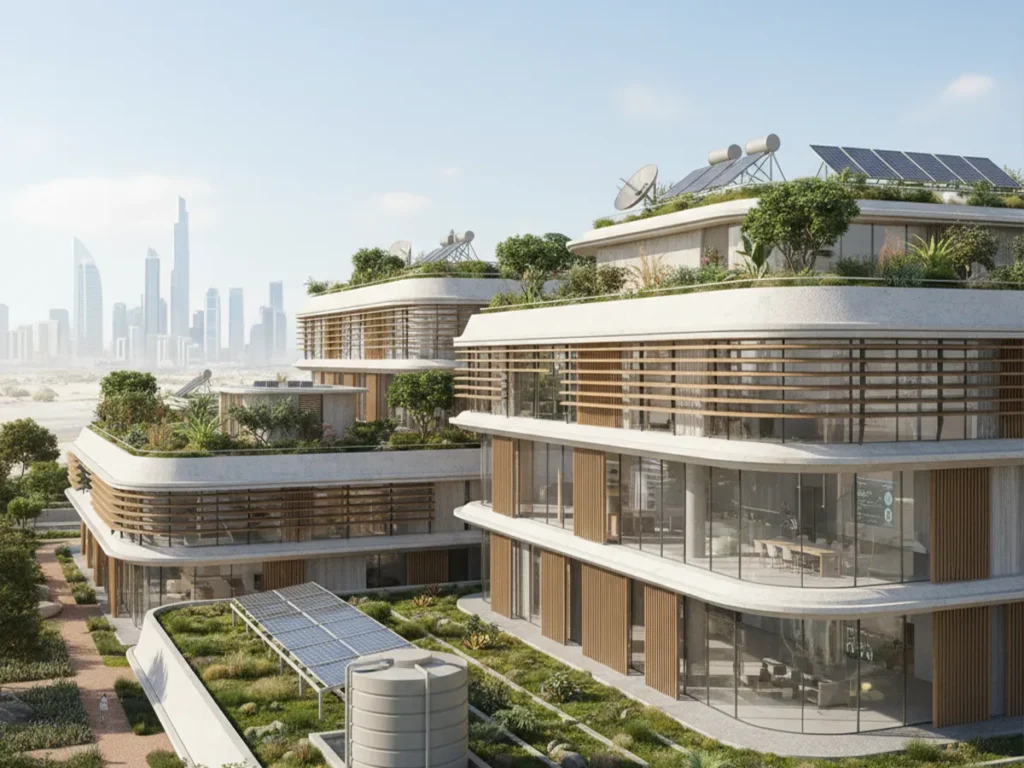
Dubai is a city of extremes—soaring skyscrapers, endless sunshine, and temperatures that regularly push past 45°C. While its architectural skyline symbolizes progress and luxury, the same desert climate poses one of the greatest challenges for sustainability. The intense heat strains air conditioning systems, drives up energy bills, and accelerates wear on materials.
So, how can we build sustainably in one of the world’s hottest environments without compromising comfort or performance?
The answer lies in adopting green building practices tailored specifically for Dubai’s desert conditions—using smart design, sustainable materials, and innovative technologies that not only survive the heat but thrive in it. In this post, we’ll explore the proven methods and materials that make sustainable construction in Dubai both practical and profitable.
In a city where cooling can account for over 70% of electricity use, sustainability isn’t optional—it’s essential. As Dubai continues to grow, the demand for energy-efficient and environmentally responsible buildings is greater than ever.
The Dubai 2040 Urban Master Plan and UAE’s Net Zero 2050 initiative have set ambitious goals to reduce carbon emissions, optimize energy use, and promote sustainable urban living. With initiatives like Estidama, LEED certification, and the Dubai Green Building Regulations, the government is leading by example—encouraging developers and homeowners alike to rethink how buildings are designed and operated.
Buildings are among the largest contributors to the “urban heat island” effect, where concrete and glass trap heat, raising local temperatures even further. Shifting toward energy-efficient buildings and eco-conscious design helps mitigate these effects while reducing utility costs.
Dubai is already home to pioneering examples like The Sustainable City, which generates more energy than it consumes, and Masdar City, a global hub for clean technology. These developments prove that sustainable living and desert climates can coexist beautifully.
Building green in Dubai means first understanding its climate—high solar radiation, sandstorms, and drastic humidity variations between day and night.
Successful sustainable design here relies heavily on passive cooling strategies, which reduce reliance on air conditioning by making the building itself part of the cooling system. These include:
An infographic titled “Heat Impact on Building Performance in Dubai” could help illustrate how temperature, sunlight, and humidity interact to affect building efficiency.
Choosing the right materials can make or break a sustainable project in the UAE. The key is durability, thermal performance, and local availability.
1. Insulated Concrete Forms (ICF) and Autoclaved Aerated Concrete (AAC)
These materials offer superior insulation while maintaining the structural strength needed for Dubai’s large-scale developments. Their thermal mass reduces temperature fluctuations, keeping interiors cooler and reducing AC loads.
2. High-Reflectivity Roofing and Facades
Cool roofs coated with reflective materials deflect sunlight instead of absorbing it. Light-colored cladding and facades further minimize heat gain, directly improving comfort and energy efficiency.
3. Recycled Steel and Locally-Sourced Aggregates
Using recycled steel and aggregates sourced within the UAE reduces the embodied carbon of a project. Local sourcing also cuts down transport emissions—an often-overlooked sustainability factor.
4. Sustainable Finishes and Insulation
Low-VOC paints, mineral-based renders, and eco-friendly insulation foams improve indoor air quality and reduce off-gassing—an important consideration in sealed, air-conditioned spaces.
Beyond materials, construction methods and smart technologies define modern green building success in Dubai.
1. Smart HVAC Systems
Air conditioning is inevitable—but waste is not. Advanced Variable Refrigerant Flow (VRF) systems and AI-controlled cooling adapt to occupancy and temperature changes, drastically improving efficiency. Energy Recovery Ventilation (ERV) units reclaim cool air that would otherwise be lost.
2. Solar Integration
With an average of 10+ hours of sunshine daily, Dubai is ideal for solar adoption. Rooftop photovoltaic panels and building-integrated solar facades can offset significant portions of a building’s electricity consumption.
3. Greywater Recycling and Desert Landscaping
Water is precious in the UAE. Modern villas and commercial developments are adopting greywater treatment systems that reuse water for irrigation and xeriscaping, a landscaping method using native desert plants to minimize irrigation needs.
4. Modular and Prefabricated Construction
Prefabrication minimizes waste, reduces site energy use, and accelerates construction timelines. Factories can precisely control resource use—leading to fewer errors and better-quality finishes.
Dubai doesn’t just encourage sustainability—it regulates and rewards it.
The Dubai Municipality Green Building Regulations mandate minimum energy efficiency and material standards for all new buildings. Developers seeking higher recognition can pursue Estidama Pearl Ratings (common in Abu Dhabi) or international certifications like LEED.
Incentives include:
Case studies such as The Sustainable City, DEWA’s net-zero energy headquarters, and the Etihad Museum showcase how integrating green principles doesn’t just comply with regulation—it delivers lasting economic and environmental rewards.
Perhaps the most common question clients ask: “Is building green more expensive?”
While initial investment costs may be slightly higher—typically 5–10% above traditional builds—the long-term return on investment (ROI) tells a different story. Lower energy and water bills, extended material lifespans, and reduced maintenance costs lead to significant savings over time.
For instance, a 500 m² villa built using sustainable methods may cut its energy costs by up to 40%, recouping the added investment within just a few years.
Sure Growth Management Services FZE plays a crucial role here. By leveraging data-driven project management, detailed cost forecasting, and live performance monitoring, Sure Growth ensures that green building ambitions stay on time and within budget. Their ability to blend cost control with sustainable innovation makes eco-conscious construction not only feasible but financially smart.
Sustainable construction isn’t just about energy—it’s about people and the planet.
For homeowners, green buildings deliver healthier indoor environments, thanks to improved air quality and better humidity control. Workers benefit from brighter, more comfortable spaces that enhance productivity.
For communities, sustainable construction reduces strain on infrastructure, conserves water, and cuts carbon emissions—directly supporting the UAE’s Net Zero 2050 vision.
Moreover, environmentally responsible projects send a strong message: that Dubai’s progress can coexist with stewardship of the planet. In a region where innovation defines identity, green building is the next frontier of excellence.
Building green in Dubai is no longer a trend—it’s the new standard. By combining innovative materials, smart technologies, and sustainable methods, the city is redefining what it means to build for the future.
As we’ve seen, the keys to success are threefold:
Dubai’s future will be shaped by those who build with intention—those who see sustainability not as a constraint, but as an opportunity for smarter growth.
So, here’s the question: What will your next project contribute to Dubai’s sustainable future?
For expert guidance in turning eco-conscious visions into tangible, cost-effective results, reach out to Sure Growth Management Services FZE, Dubai’s trusted specialists in sustainable construction and green project management.
SURE GROWTH MANAGEMENT SERVICES FZE are a management consultancy in the UAE specialising in commercial and project management for the development and construction sectors.
Unit 203 Clover Bay Tower, Business Bay, Dubai
+971 585670183
info@suregrowth.ae
© 2026 Sure Growth. – All rights reserved. Designed & Developed By : 
Need help? Our team is just a message away